
During the winter, the safety of your vehicle depends not only on good driving as it begins with the appropriate tires. Frozen roads, ice spots, and temperatures that make the unprotected hands fall off, require more than ordinary tires can deliver to ensure a sufficient grip and performance. Enter snow tires. Snow tires also have deeper treads and special rubberized compounds and they provide that much needed traction and control when the weather gets slippery.
However, the most important thing is to know how to replace the snow tires and also know when to do it making it no better than having the snow tires. But you might be that DIY type of person or merely reading about it all to call to schedule a mobile tire change of snow tires, but either way, this blog guides you on how to change snow tires. You will find all the professional tips on when and how to change tires successfully and prevent some of the typical issues. Feeling confident to take the cold pavement?
When Should You Change Snow Tires
Whether to know when to change snow tire is equally considered as crucial information as how to fit on snow tires. All the difference can be in timing of your vehicle performance and safety.
Best Time of Year to Switch to Snow Tires
As a rule of thumb, the most suitable idea is to change to snow tires as temperatures routinely fall below 45 degrees Fahrenheit (7 degrees Celsius). This is when the ordinary all season or summer tires start to slip-up in grip and flexibility. The installation of winter tires is planned by most persons in October/November, based on location.
How Temperature Affects Tire Performance
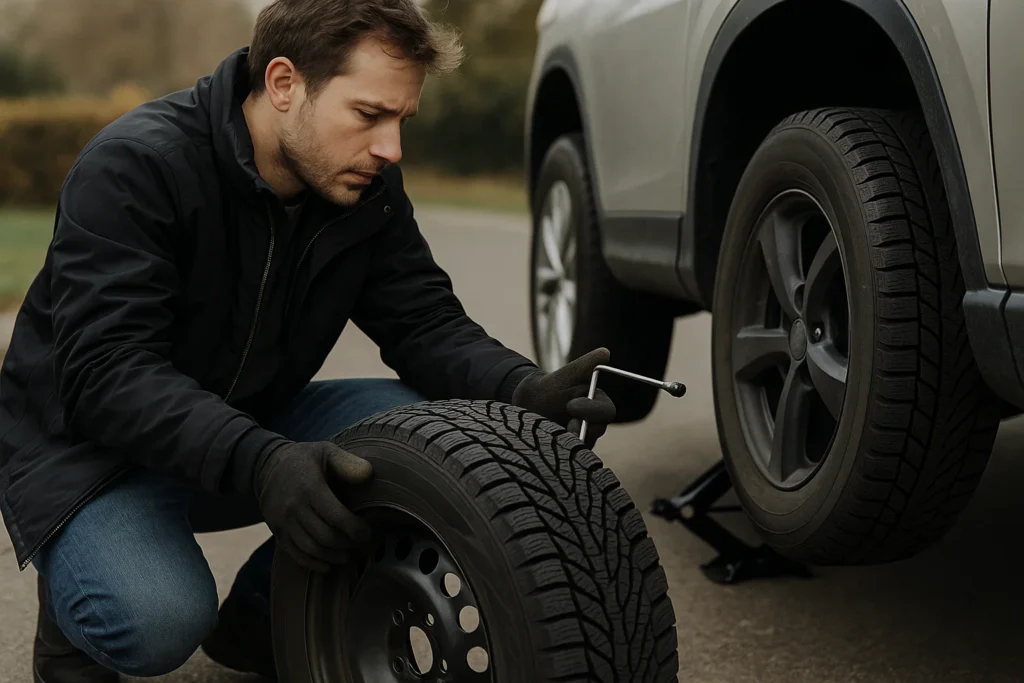
Rubber products in summer- or all-season tires get stiff due to cold temperatures, which minimizes traction. Snow tires are of special rubber compound, which remains pliable at low temperatures, such as freezing temperatures, and keeps road contact and control. Therefore, winter tires have better performance even in cold weather when there is no sign of snow.
Signs It’s Time to Install Winter Tires
- Harmonious freezing weather
- Icy or snowy conditions forecasted
- Causes a perceivable loss of traction on the morning commutes
- Past history of sliding or skidding during this kind of weather
When any of these symptoms appear, it is time to consider having a snow tire swap at a local tire shop or consider doing it yourself on your own turf.
How to Change Snow Tires – Step-by-Step Instructions
Here we are now down to the very depths of this winter tire guide, how to make a proper and safe snow tire switch. It is best to follow the right procedure whether it is your first time or you are shifting to winter tires when adapting the best approach to keep your car in a great shape all through the winter. Snow tire installation process is listed in detail below in step by step sequence.
Step 1 – Prepare Your Vehicle and Area
The most important thing to remember before you start is preparation. Collect all the required equipment and ensure that you are in a secure, well-regulated area – preferably flooded with good light, on a flat driveway or a garage floor.
You will require following tools, equipment:
- A complete winter set of tires (be sure they are of the specification which fits and can roll so that they are not worn out)
- Lug wrench/tire iron Hydraulic or scissor jack Jack is a word of extra safety Torque wrench
- Wheel blocks Work gloves
- Begin by pulling your car to a level ground and by anchoring the parking brake.
Put wheel chocks behind the tires, which should not be removed to immobilize the car. This will be his essential step so as to guarantee your safety prior to vehicle lift.
Step 2 – Loosen the Lug Nuts
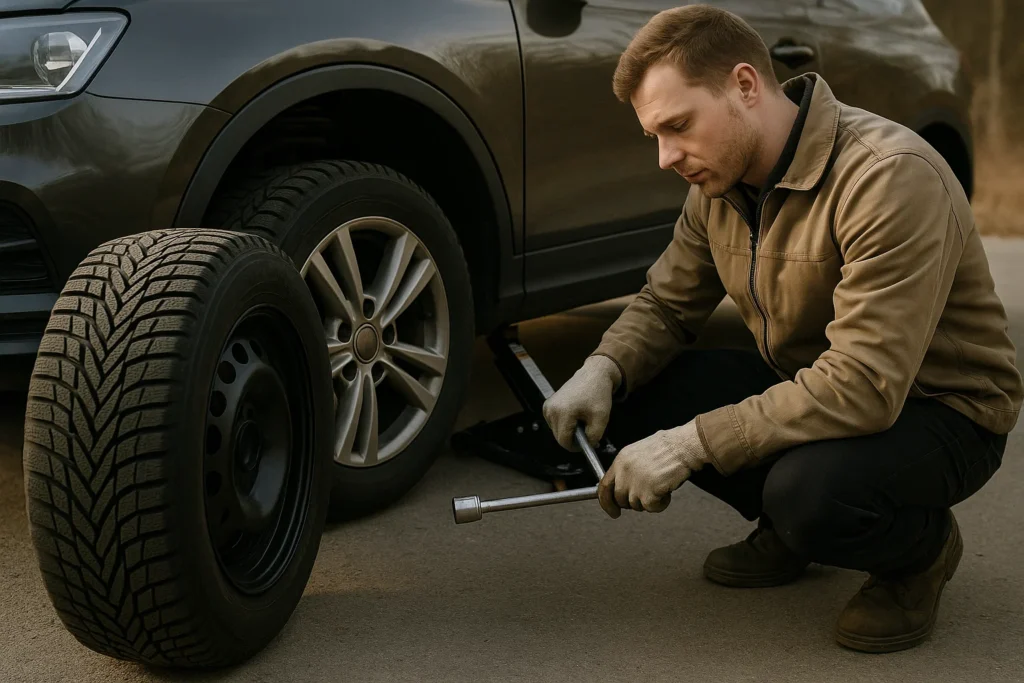
With your lug wrench, turn all of the lug nuts on the wheel which is going to be changed first loosely (not removed), but do not turn so loosely that you may drop the nuts. It should be done when the tire is still in contact with the ground because you will get additional resistance and stability. Rotate the lug nuts in a clockwise direction so as to break the initial torque. In the event that they are too tight, a little bit of force with your foot or a breaker bar can solve the problem.
Step 3 – Jack Up the Vehicle Safely
Next find the designated jack points on your car which are typically located along the frame behind the front wheels and in front of the rear wheels. Lift the car gradually until the tire is off the ground after positioning the jack beneath the proper point. When the car is only supported by a jack never crawl underneath it. After the car has been raised always use jack stands to secure it. If the jack slips or fails this avoids mishaps.
Step 4 – Remove Regular Tires and Install Snow Tires
The vehicle will be safely raised and supported after this.
- Take out all of the lug nuts and place them in a secure location.
- Remove the standard tire from the wheel hub with caution then place it aside. Align the holes on your snow tire with the bolts or wheel studs.
- Make sure the snow tire fits flush with the mounting surface as you carefully slide it onto the hub.
If you’re using directional tires which need to be mounted to rotate in a specific direction indicated on the sidewall, make sure the tire is installed correctly before continuing.
Step 5 – Tighten Lug Nuts and Lower the Vehicle
Using a crisscross or star pattern manually tighten the lug nuts onto the bolts after the snow tire is in position. By ensuring uniform pressure on the wheel this pattern helps the wheel seat correctly and lowers the possibility of the brake rotor warping. Use your jack to carefully lower the car back to the ground after the lug nuts are hand-tight.
Step 6 – Torque Lug Nuts to Manufacturer’s Spec
Now that the car is on the ground its time to tighten the lug nuts. Each lug nut should be tightened using a torque wrench to the torque specified in the owners manual for your car. Although it varies by make and model this usually falls between 80 and 100 lb-ft. Once more torque using the star pattern to keep the pressure constant. This last step makes sure your wheels are securely fastened which lowers the possibility of a wheel coming loose or wearing unevenly while youre driving in the winter.
Common Mistakes to Avoid When Changing to Snow Tires
Tiny details that impact tire performance and safety can be missed by even experienced do-it-yourselfers. Here are some things to look out for.
Mixing Tire Types or Brands
One of the most common mistakes is to only install snow tires on the front or rear axle. Matching snow tires on all four wheels are necessary to ensure balanced traction and handling.
Ignoring Tire Pressure After Installation
Tire pressure drops in colder climates. After installation make sure your tires are inflated to the PSI that is advised by the placard on your car.
Forgetting to Check Tire Rotation Pattern
Asymmetrical and directional snow tires are both possible. Their efficacy is diminished when installed incorrectly. Indicators or arrows indicating the proper rotation direction should be visible on the sidewall.
Final Thoughts
witching to snow tires is a commitment to safety traction and confidence on icy roads not just a seasonal chore. The right timing and technique can make all the difference whether you choose to do it yourself or hire a snow tire change service in your area. Every step matters in ensuring the safety of you and your passengers throughout the winter from planning to tightening the lug nuts.
Additionally if you’re looking for dependable on-site snow tire change services trust the experts at All 4 One Transportation. Be prepared be careful and allow us to guide you through the winter one step at a time. Since winter doesn’t wait give All 4 One Transportation a call right now to arrange for your snow tire change.
FAQs
If you’re doing it yourself changing all four tires typically takes 45 to 1 hour. Usually, a qualified mobile tire service can finish it even more quickly.
Indeed, in order to guarantee constant traction and control snow tires ought to be mounted on all four wheels.
Although its technically possible using snow tires in the summer is not advised. Snow tires perform worse on dry roads and deteriorate more quickly in warm weather. Return to summer or all-season tires in the spring.